Showcase Game UI

Cozy Factory: a game UI in Meadow glass

The interface of Cozy Factory, a calm factory builder for the browser: the HUD, machine panels and pop-ups in “Meadow glass”, frosted panels with rims, rivets and leaves, drawn in Polyform from one shared kit of components.

  1920 × 1080
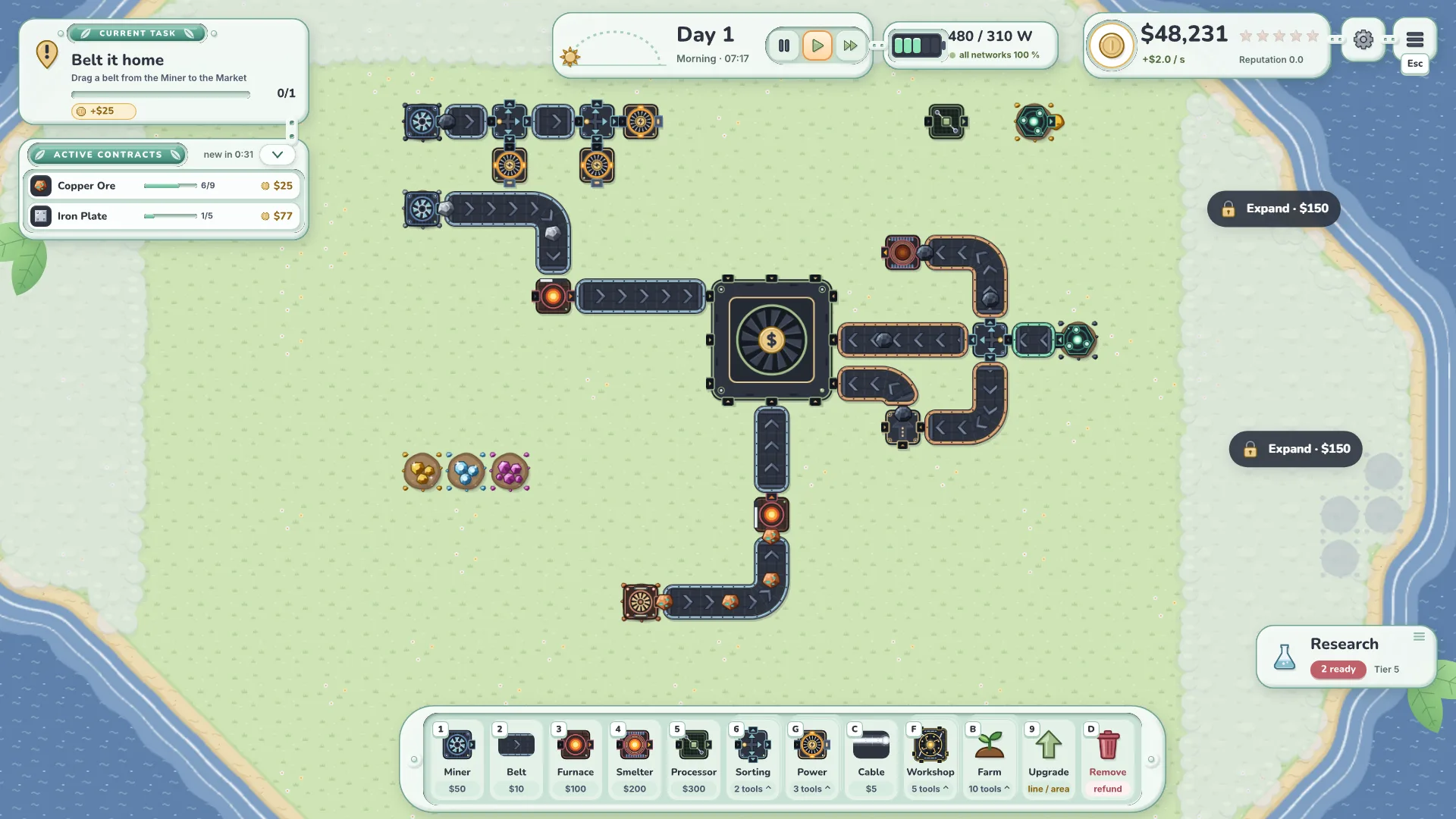
A light green island from above, dark conveyor belts and machines around a central market. Frosted panels sit on top: a task card and two contracts at the top left, a clock, a power meter and $48,231 at the top, and a toolbar of machines below.

A factory builder that feels like a greenhouse

Cozy Factory is a calm factory builder on a sleepy archipelago: you place miners, belt the ore to a market and grow from there. Its interface is called Meadow glass. Panels are frosted glass on a pale sage ground, held by rims, rivets and grooves, with leaves tucked behind the frames.

The world behind each frame is a capture of the running game, and the machine and item sprites are the game's own art, made as SVG by its art scripts and placed as images. The panels, cards, gauges and type on top are drawn in Polyform.

  HUD, early game — 1920 × 1080

A light green island from above, dark conveyor belts and machines around a central market. Frosted panels sit on top: a task card and two contracts at the top left, a clock, a power meter and $48,231 at the top, and a toolbar of machines below.
The HUD in the first minutes: the current task, two contracts, the day clock, power and the wallet, with the build toolbar along the bottom. The collapsed contracts module was designed in this frame first, then built.

  Machine Detail · Garden — 1920 × 1080

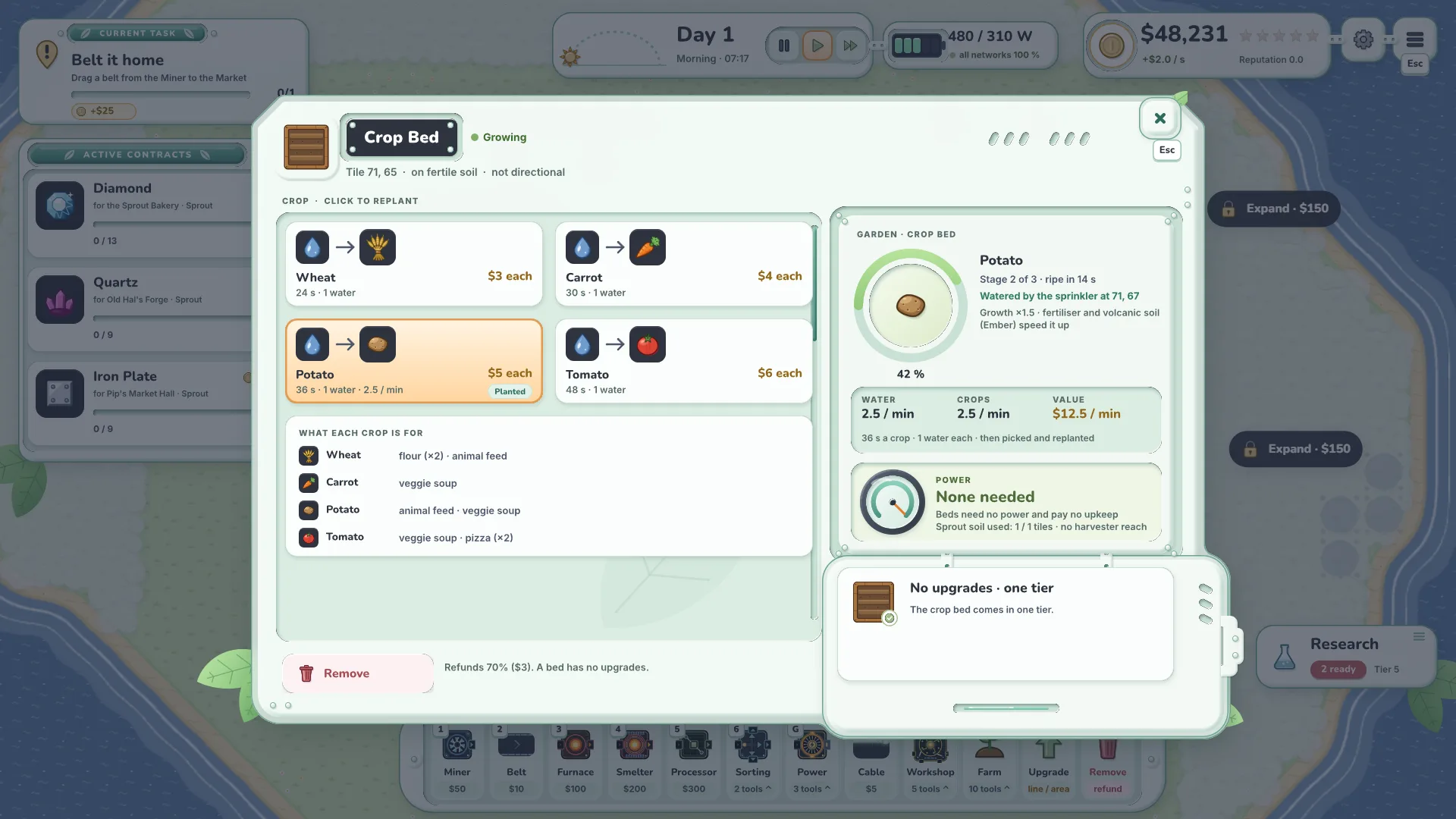
A frosted panel titled Crop Bed over the dimmed game. On the left, four crop cards: wheat, carrot, potato (picked) and tomato. On the right, a ring at 42 % around a potato, water and value figures, a dial reading None needed, and a note: no upgrades.
A crop bed growing potatoes, in the housing every machine shares: four crops to pick from, a ripeness ring, water and yield, and a power gauge. Drawn after the build, from a capture of the game.

  Research — 1920 × 1080

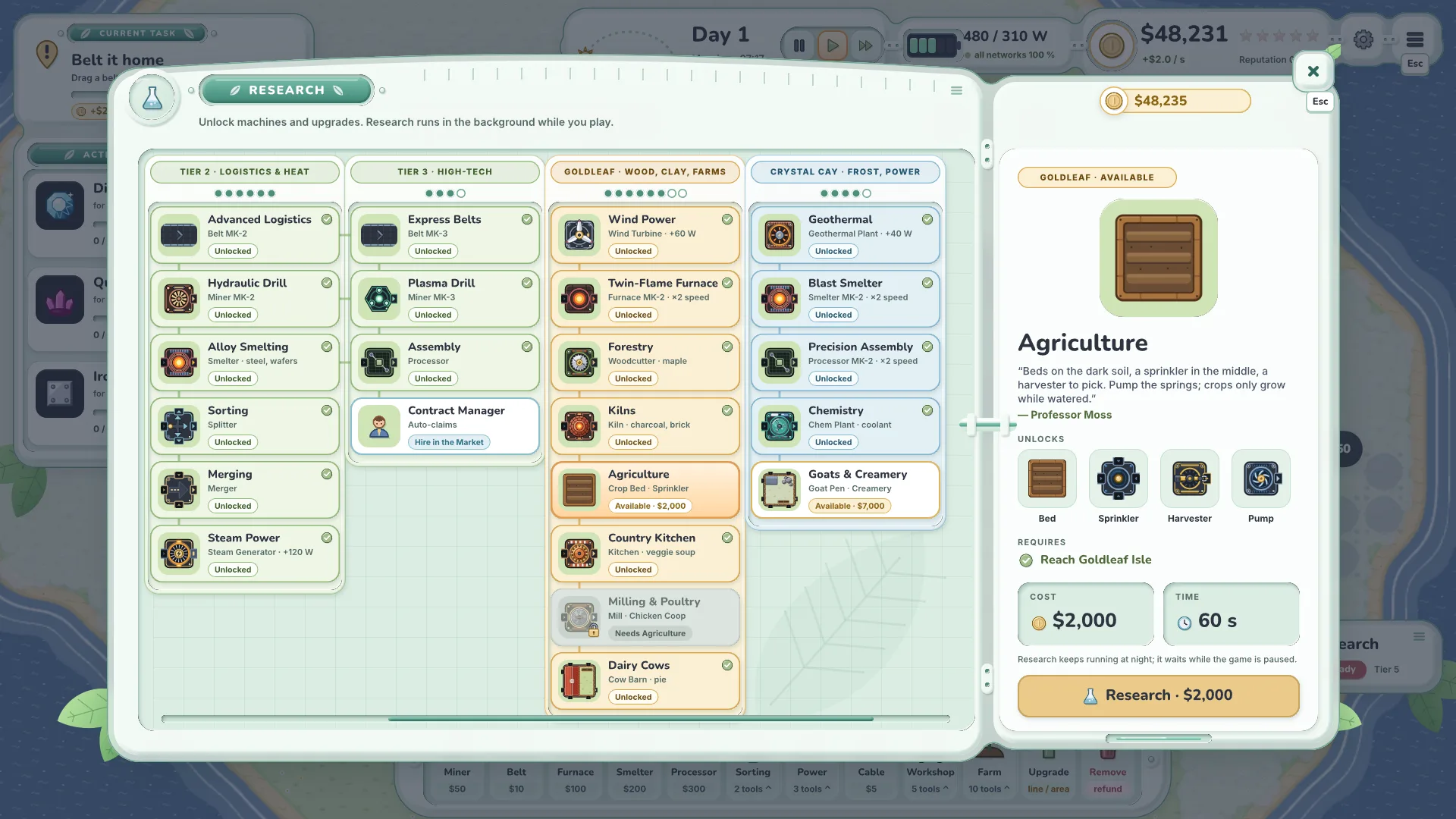
A wide frosted panel titled Research with four columns of small cards in green, honey and blue, most marked Unlocked. A side panel shows Agriculture: a crop bed, a quote, four unlocks, $2,000, 60 seconds and a Research button.
Research as a greenhouse board: four columns of tech, each tinted by its island, and a side panel for the selected one, Agriculture. This is the adopted design; the game built it with small changes.

  End of Day — 1920 × 1080

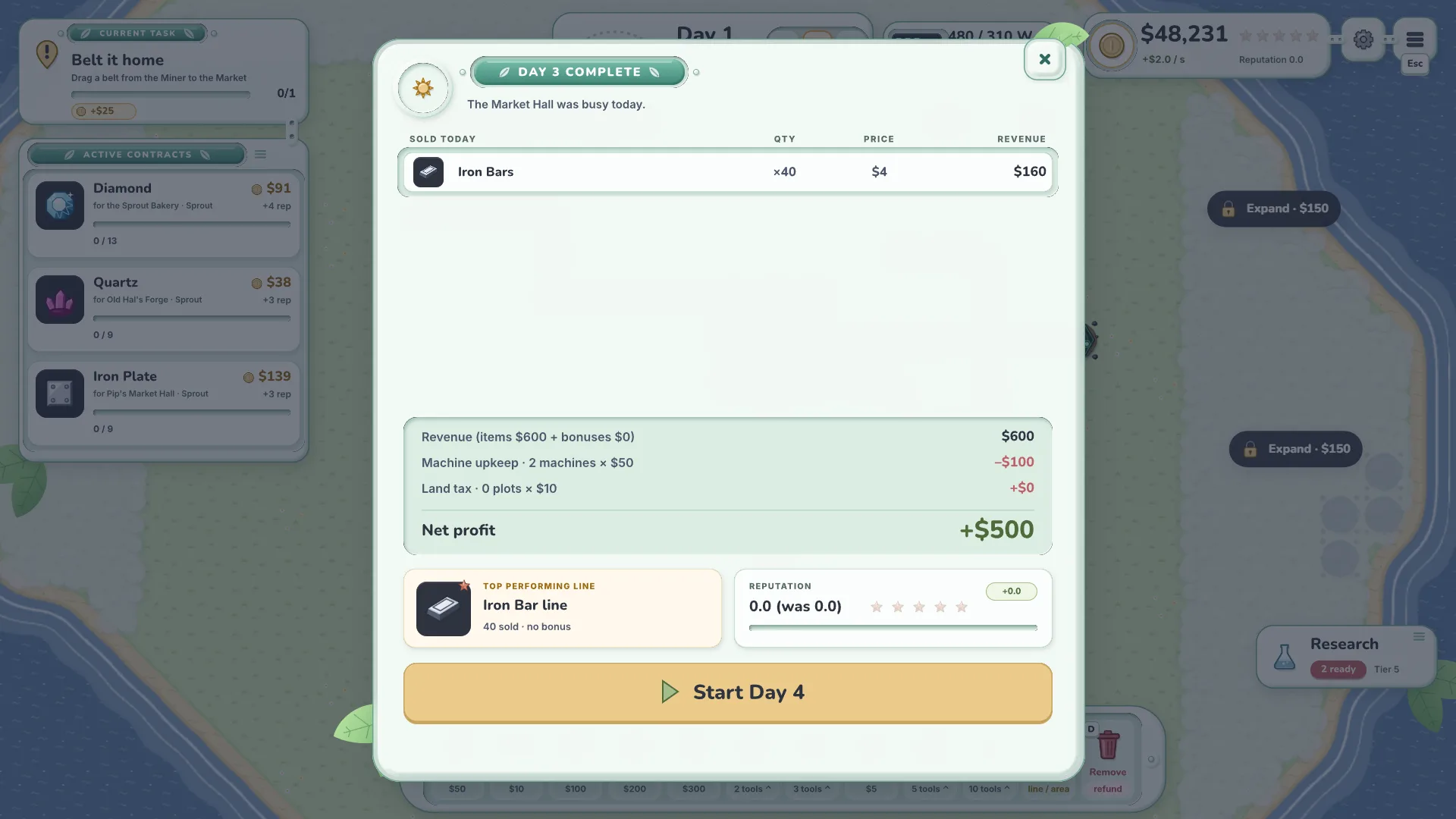
A frosted pop-up headed Day 3 complete. One row reads Iron Bars, 40 sold at $4, $160. Below: revenue $600, upkeep −$100, net profit +$500, a card for the top line and a reputation card, and a wide honey button reading Start Day 4.
The end of a day: what sold, the upkeep and the net profit, the best line and the reputation, then Start Day 4. Drawn after the build, from a capture of the game.

One light, one kit

Every part is lit the same way: one light from the top left at 45°. Raised parts catch it on their top-left edge and drop a short teal shadow; sunken fields and grooves take an inner shadow from the top left. Nothing is lit from below, and nothing casts a black shadow.

The parts are components, kept on one page: rims, rivets, grooves, portholes, leaves, the close tab, gauges, and the machine housing itself. Each screen places them as instances, so changing one part changes every screen that uses it. Raised parts use Polyform's bevel material, and the frosted panels its glass material.

  Detail kit · one light — 1360 × 1180
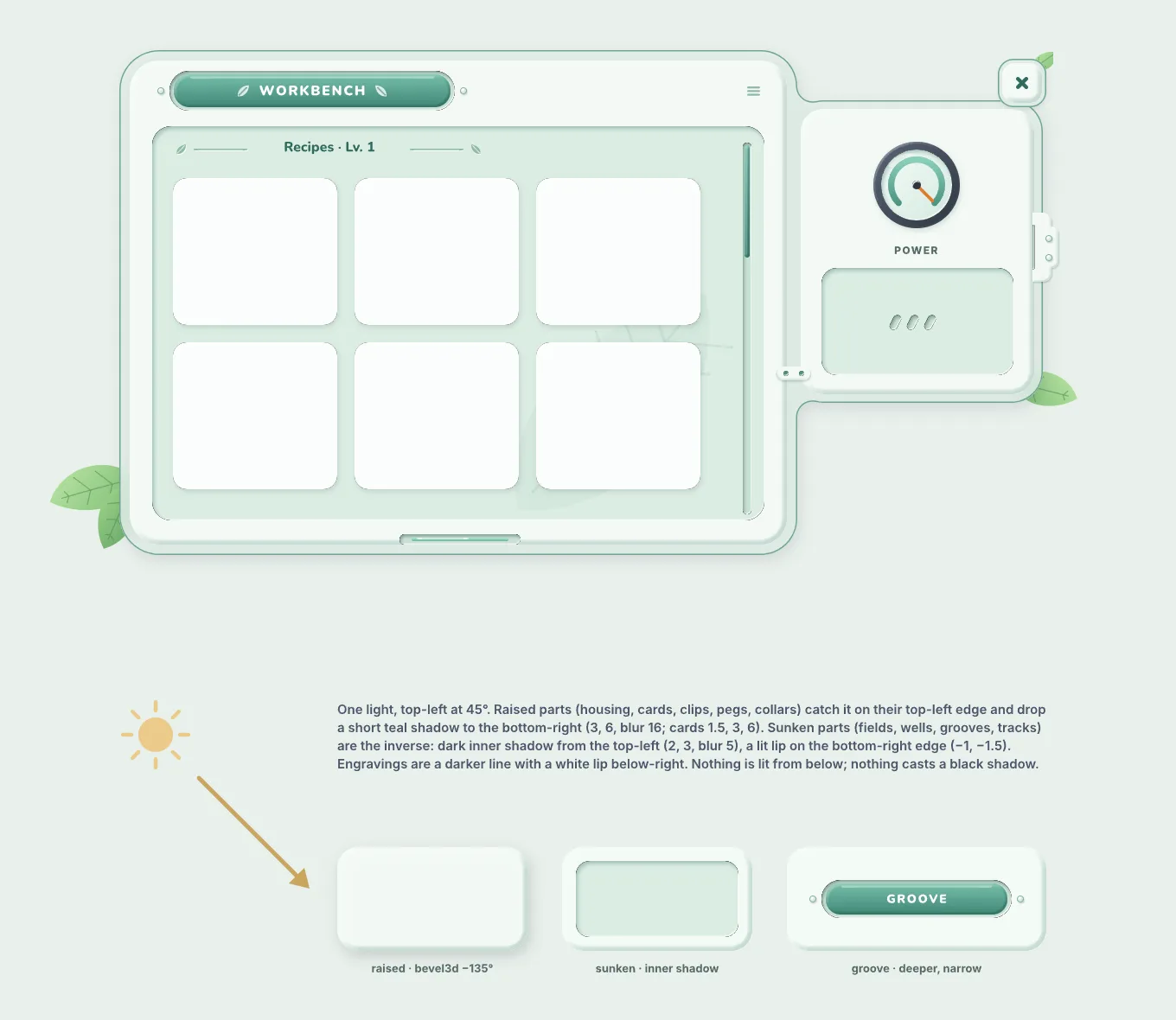
A pale green sheet. At the top, an empty Workbench panel with six recipe slots and a power dial. Below, a small sun with an arrow pointing down-right, a paragraph on the lighting rule, and three samples labelled raised, sunken and groove.
From the detail kit: a Workbench panel put together from the kit's parts, and the lighting rule with its three surfaces: raised, sunken and groove.

From the file

  • Frames: 4 pictures of 1920 × 1080 frames (the HUD, Machine Detail, Research and End of Day) and part of the detail kit; the four frames hold 1,641 layers.
  • Colours: #F4FAF6 panels; #C9E2D4, #9CC3B2 and #83AE9C rims; #4E8E7C teal grooves; #2E3440 slate; #4C566A and #556A66 text; #E0B45A honey.
  • Type: Inter 500 to 800 for live text; Nunito display text set as outlines.
  • Made with: 213 instances of 46 components; a bevel material on 93 layers and glass on 11; 301 inner shadows and 247 drop shadows; 13 tilemaps (the toolbar's slots, the power meter's cells).
Credits
  • Design — AndreaDev3D
  • Write-up — drafted with Claude, reviewed by AndreaDev3D
  • Drawn with — Claude Code over Polyform's MCP server
Tools

Polyform

Licence

© 2026 AndreaDev3D. All rights reserved.
AndreaDev3D

@andreadev3d

Software and game engineer, 10+ years shipping apps, websites and games. Now building Polyform, a local-first design app for the desktop.

More by AndreaDev3D

See all 5